

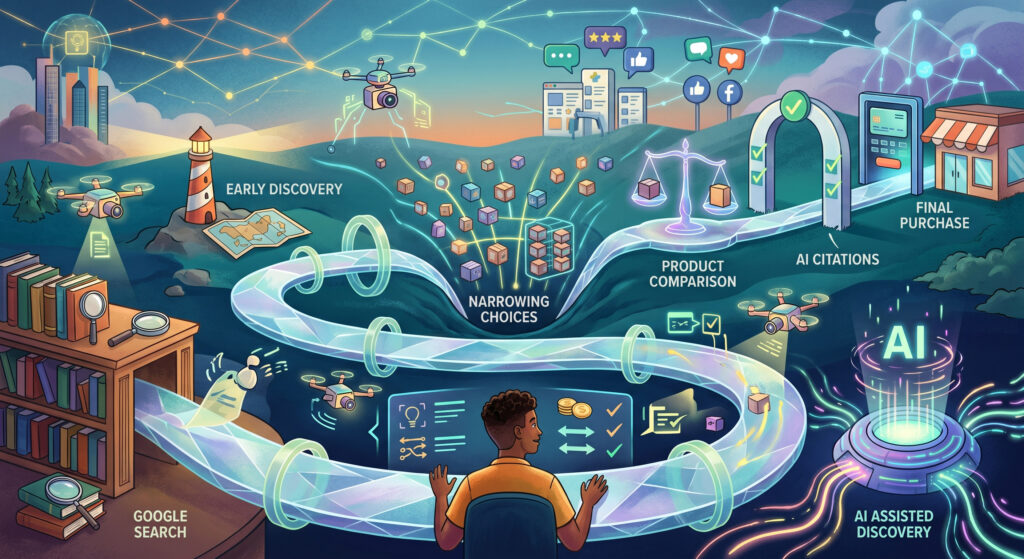
Consumers' growing trust in ai-assisted discovery and shopping (new study)
We’ve spent years debating whether AI would eventually replace Google. That debate, it turns out, may have been asking the wrong question. A new survey of over 1,000 U.S. consumers conducted by Semrush in December 2025 paints a far more nuanced picture: AI has embedded itself throughout the entire purchase process, working alongside traditional search rather than against it.
AI Use Is Already a Daily Habit for Most Consumers
The survey found that 85% of respondents use AI tools at least weekly, with 48% doing so every single day. A quarter of respondents open an AI tool multiple times per day. For product research specifically, 55% of consumers use AI at least once a week. These are habitual behaviours, deeply woven into how people gather information online.
The dominant platforms, by monthly active usage:
- ChatGPT: 64%
- Google Gemini (including within Google Search): 49%
- Meta AI across Instagram, Facebook, and WhatsApp: 39%
- Microsoft Copilot: 35%
- Google AI Mode: 28%
Grok, Perplexity, and Claude trail with single-digit or low double-digit figures among general consumers, though they likely see higher adoption among professional and technical audiences. The concentration of usage around a small number of platforms is useful for brands: you do not need to optimise for every AI tool in existence. Focus on the few that actually reach your audience.
Consumers Use AI Across Every Stage of the Purchase Funnel
Perhaps the biggest misconception about AI in commerce is that it operates at the top of the funnel, helping people explore options broadly before handing off to Google. The data tells a different story.
- 57% use AI to narrow down their choices
- 53% compare products they already have in mind
- 51% use it for early discovery and understanding what they need
- 50% rely on it to help make a final decision
AI is present throughout the entire decision process. It helps consumers figure out what they want, filter the field, compare the finalists, and land on a purchase. Brands that appear only in early-stage AI conversations may miss consumers who are already close to buying.
How Consumers Actually Ask AI About Products
The queries consumers bring to AI tools are significantly more specific and structured than a typical Google search.
- 52% include constraints upfront, such as budget limits, required features, or compatibility needs
- 43% start with a broad question before refining
- 33% engage in back-and-forth with the AI, revising their question multiple times
Brands take note: if your product descriptions, web content, and third-party coverage do not address concrete use cases, constraints, and comparisons, you are less likely to surface when it counts.
AI and Google Are Working Together, Not Against Each Other
The “AI vs. search” framing misrepresents how consumers actually behave. According to the survey, 77% of respondents use AI tools and search engines together during research, with Google remaining the more common starting point at 33% compared to AI at 26%.
Only 4% rely primarily on AI and skip search altogether.
The workflow often looks like this:
- A consumer starts with AI to understand a category or generate a shortlist
- They move to Google to verify prices, read reviews, or go deeper on a specific brand
- They may return to AI for final comparisons
Ranking in traditional search and surfacing in AI responses are complementary goals, and pursuing one while ignoring the other leaves significant visibility on the table. It is also worth noting that 94% of consumers click links in AI responses at least occasionally, with 38% doing so often or almost always. AI citations drive real traffic.
Being Mentioned in AI Responses Opens Doors for Brands
The survey found that 43% of respondents have discovered a new brand through an AI tool, and 47% report noticing brands mentioned in AI responses regularly. When AI mentions a brand, consumers do not ignore it. Here is what they do next:
- 40% search Google for additional information about that brand
- 36% use Google to compare it with alternatives
- 34% ask the AI follow-up questions about the brand
- 28% go directly to that brand’s website
Only 8% ignore a brand mention unless they already have prior familiarity with it.
Position in the AI Response Matters Less Than the Description
Ranking earlier in an AI response has only a modest effect on consumer attention: only 20% say they notice a brand because it appeared higher in the answer.
What actually draws attention:
- 43% respond to a clearer, more detailed explanation of the brand or product
- 39% take note of price and value framing
- 37% are drawn in when the description matches their specific needs
- 28% pay attention when a direct comparison to alternatives is included
The quality and relevance of how your brand is described in an AI response carries far greater weight than your position within it.
Consumers Trust AI Recommendations, With One Condition
75% of respondents rate their trust in AI recommendations at 3 or 4 out of 5. Full trust is relatively rare: only 20% say they trust AI completely, and very few express outright distrust. This conditional trust has a predictable outcome: verification. 86% of consumers verify AI brand recommendations through other sources before committing, with 20% doing so every time.
Where they go to verify:
- Google or other search engines: 68%
- Brand websites: 48%
- Review sites: 35%
- YouTube: 35%
- Friends or family: 33%
- Social media: 30%
For brands, this means an AI mention opens an investigation. Consumers will look you up. Your Google presence, website, and third-party review footprint all need to hold up under scrutiny.
AI Is Already Driving Real Purchases
50% of consumers have purchased after using AI during their research. A smaller but meaningful 22% have completed a purchase directly within an AI tool, via features like ChatGPT Shopping.
The categories where AI influence shows up most:
- Retail and consumer goods: 39%
- Restaurants and food delivery: 29%
- Health and wellness: 29%
- Consumer electronics: 27%
- Travel and hospitality: 21%
Higher-consideration categories like education, home services, and financial products also show meaningful AI influence, even if at lower rates. 37% of consumers say they rely on AI most for mid-range purchases such as subscriptions and electronics, while 28% use it for high-cost or high-stakes decisions. 36% apply it equally across all purchase types. AI is active across price points, not confined to low-risk or impulse buys.
The Trajectory Points in One Direction
69% of respondents expect AI to play a larger role in how they shop in the future. Only 3% expect that role to shrink.
Consumers also anticipate pulling back from other research channels as AI improves:
- 46% expect to rely less on traditional search engines
- 42% expect to reduce their use of social media for research
- 34% expect to consult review sites less frequently
- 33% expect less reliance on influencers
Data sourced from Semrush’s survey of 1,030 U.S. consumers conducted in December 2025.
Our take
The insights from the Semrush study signal a definitive shift from a linear, search-first journey to a “hybrid discovery” model. The journey is now compressed, fragmented, and constantly looping between AI, search, and brand touchpoints. For brands, this means you’re no longer competing only on visibility in one channel—you’re competing on how well your story holds together across every moment of evaluation. At TMI, we view this not as the death of SEO, but as its evolution into a broader digital brand visibility framework. That changes the game from “how do we get traffic” to “how do we get chosen when the decision is being shaped upstream.” The window for treating AI visibility as “optional” has officially closed. These findings are a call to action for brands to move toward holistic authority.
It means that brand building and performance can no longer be treated as separate disciplines. AI is filtering options upfront, but trust is still earned elsewhere. So if your paid media, organic search presence, website experience, reviews, and third-party validation don’t align, the whole system breaks. Brands need to think in ecosystems, not channels. There’s also a subtle erosion of brand storytelling as we know it. Long-form narratives and layered messaging struggle to survive in this space where answers are summarised and condensed. That doesn’t mean the story disappears, but it does mean it needs to be built in fragments. Each piece must hold its own, while still connecting back to a bigger picture when stitched together.
It furthermore reframes trust. Trust is no longer built only through direct brand storytelling or even peer reviews; it’s inferred through presence, repetition, and contextual relevance across multiple sources that AI systems pull from. If a brand shows up sparsely or inconsistently, it doesn’t just lose visibility; it loses implied credibility. The brands most at risk aren’t the ones with bad marketing. They’re the ones with vague marketing. Generic value propositions and broad positioning are increasingly invisible to AI systems that are trying to match specific needs to specific solutions.
We spend a lot of time working inside these dynamics, understanding how brand information travels across AI responses, what signals seem to earn visibility, and where gaps tend to appear between how a brand sees itself and how the wider web reflects it back. That gap is where the real work happens.
If you want to understand where your brand currently stands in this environment, or you’re ready to think seriously about how you’re positioning yourself for this era of discovery, we’d love that conversation. Reach out to us at TMI Collective — let’s dig into it together.